World’s Fastest Clapper
Saturday, 01 August 2009 | 3 Comments
Here’s a quirky little activity that uses the DER laptops.
I’ve been using this video of the world’s fastest clapper to engage the students at the start of a lesson about rates.
As I’m teaching lessons, and knowing the laptops will hit our school soon, I’ve been trying to think about how I can include the laptops in existing lessons.
First up, this fits into the NSW Syllabus:
NS4.3 Operates with fractions, decimals, percentages, ratios and rates
- Students learn about calculating rates from given information
- Students learn to solve a variety of real-life problems involving rates
Whilst Year 9 are the recipients of the laptops (technically Stage 5) , we review ratio and rates (Stage 4) in Year 10.
Back to the video. Kent “Toast” French claims in the video that he hits 14 claps per second. How can we check? We can’t count it.
I used a Mac application called Audio Hijack Pro to extract the audio of the video into an MP3 file. There might be a way to extract the audio on the DER laptop, but I haven’t investigated.
Fast Clapping MP3 (345 KB)
When you load this MP3 file into Audacity you see the waveform.
Throughout this post, click the images for a larger view.
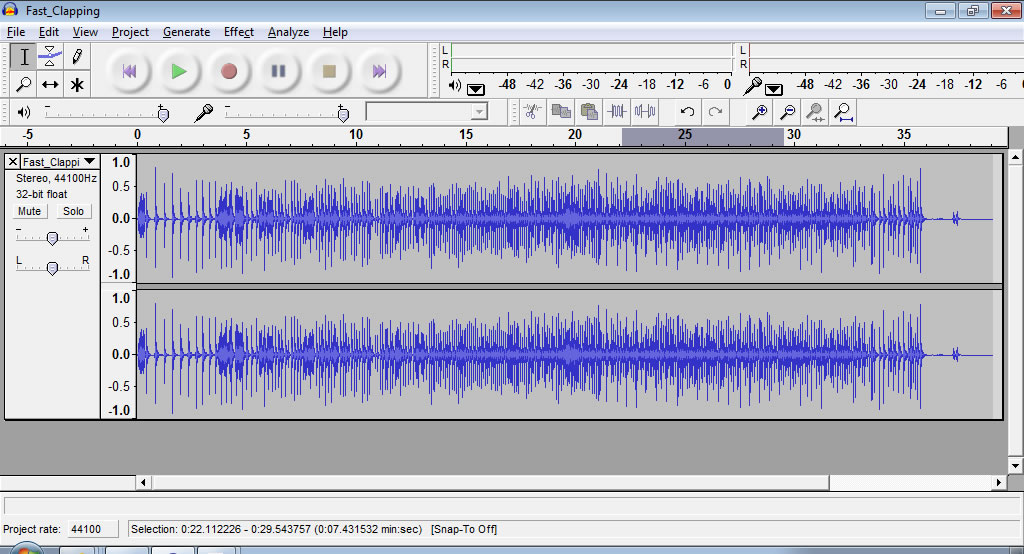
But to measure you’ll need to zoom in to the waveform after Kent says “one more gear”.
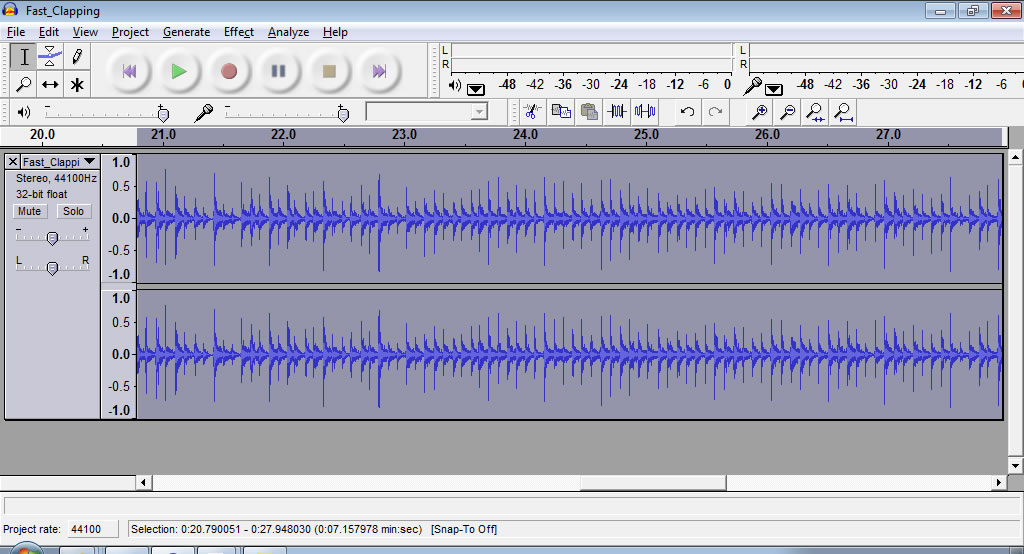
Now you can start to see the individual claps. To measure you can zoom in further to see a second.
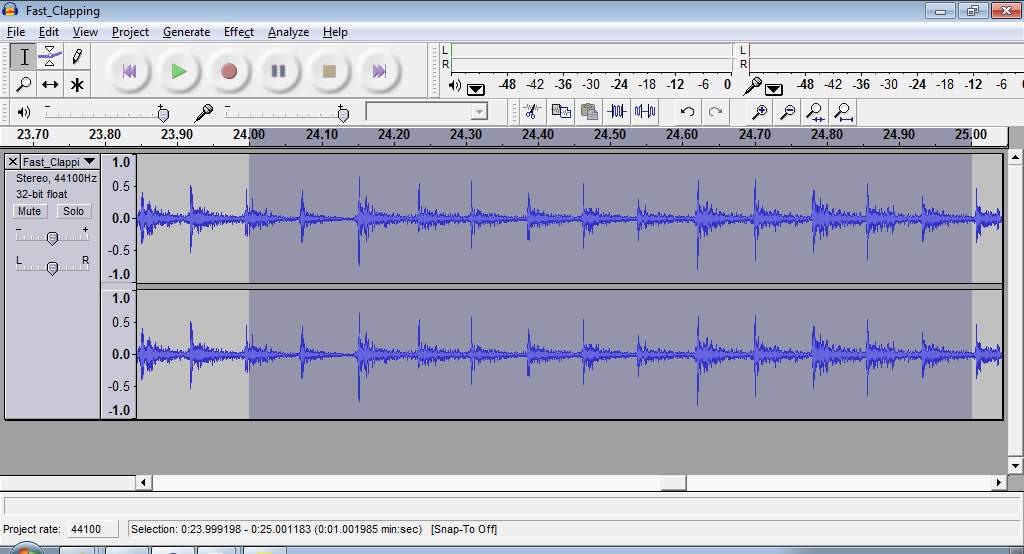
From that, I’d say Kent reached 13 claps per second (in the selection I made).
Taking this further:
- get the students to record their own fast clapping straight into Audacity and measure
- you could mark 100m on the road outside your school, and video cars going by. Back in the classroom, you could work out the speed by analysing using Adobe Premiere Elements.
A little different to normal, I’ve made a PDF file of this post with the good resolution screenshots if you want to share it with others.
Posted in • Lesson Idea • Rates • Media • Audio • Software • Audacity • Technology • Digital Education Revolution • Laptops 4 Learning | Short URL: http://mths.co/1595
Post a comment
Commenting is not available in this channel entry.New Subscribe to the …
MathsLinksemail newsletter
Get updates…
About
Simon Job — eleventh year of teaching maths in a public high school in Western Sydney, Australia.
MathsClass is about teaching and learning in a maths classroom. more→
Archive
Elsewhere
 @simonjob
updates via @mathslinks
Recently read/found.
Sydney University abandons HSC prerequisites in diversity push
mathsSeven ways to use diagnostic questions to check for understanding
maths bartonDeveloping a departmental approach to problem-solving
maths bartonDeveloping a departmental approach to reviewing answers
maths bartonDeveloping a departmental approach to worked examples
maths barton workedexamples examples
Comments